The Economic Status of Women in the U.S. What Has Changed in the Last 20 – 40 Years
Heidi Hartmann, Ph.D. presents to the GAO.

Heidi Hartmann, Ph.D. presents to the GAO.
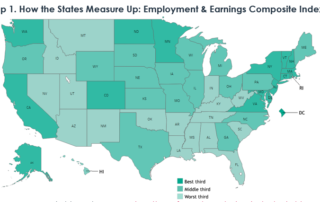
This Fact Sheet presents findings from analysis of the Employment & Earnings Index and Poverty & Opportunity Index of The Status of Women in the States series, a comprehensive project that presents and analyzes data for all 50 states and the District of Columbia.
This report provides critical data illuminating the status of women in Lubbock County, in terms of their civic engagement, health outcomes, vulnerability to poverty, and access to employment, education, and entrepreneurial opportunities.
Like intimate partner violence, sexual assault, and stalking, human trafficking[i] has significant economic consequences for victims. While data on the prevalence of human trafficking in the United States are scarce, due to the covert nature of the crime, some research suggests that trafficking is widespread.
Black women disproportionately experience violence at home, at school, [...]
This report aims to amplify the historical and current contributions of Black domestic workers to the broader domestic worker movement. Using available data, the report describes the experiences of millions of Black women across the United States, and offers recommendations where the opportunities for Black women can be realized.
This briefing paper highlights demographic information relevant to the status of women in Florida. It explores differences between women and men on a range of variables, including age, race and ethnicity, marital status, household type, immigration status, geography, and veteran status.
Of the 14.1 million girls and young women of color, age 10–24, in the United States, 40.7 percent (5,748,760) live in the South, 23.2 percent in the Pacific West, 14.9 percent in the Northeast, 10.4 percent in East North Central, 7.3 percent in the Mountain West, and 3.5 percent in West North Central, as shown in Map 1.
Of the 42.3 million women of color, age 18 and older, in the United States, 41.5 percent (17,537,563) live in the South, 23.2 percent in the Pacific West, 16.3 percent in the Northeast, 9.8 percent in East North Central, 6.4 percent in the Mountain West, and 2.9 percent in West North Central.
Institute for Women’s Policy Research (IWPR) analysis of data from the American Community Survey finds that between 2004 and 2014, Black women’s real median annual earnings for full-time, year-round work declined by 5.0 percent—more than three times as much as women’s earnings overall.