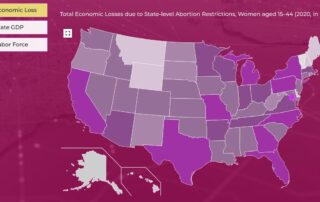
New IWPR Analysis Reveals Economic Harm of State Abortion Bans
IWPR's latest report points to a clear correlation between abortion restrictions and economic underperformance, further highlighting that restrictions or total bans on abortion care not only jeopardize women’s health but actively harm state economies.
IWPR Launches Connect for Success Initiative to Expand Sexual and Reproductive Health Services for Community College Students
IWPR has proudly announced the launch of its new initiative, Connect for Success—a groundbreaking initiative aiming to significantly increase community college students' access to high-quality, comprehensive sexual and reproductive health (SRH) care services. The initiative starts with awards to eleven grantees across the country working on the ground to provide students with the support they need to succeed.
National Gender Wage Gap Widens in 2023 for the First Time in 20 Years, With Women Making 82.7 Cents on the Dollar Compared to Men, Down from 84 Cents in 2022
“The worsening gender wage gap is a national disgrace," says IWPR President and CEO Dr. Jamila K. Taylor.
Supreme Court Rejects Far Right Effort to Restrict Access to Medication Abortions and Mifepristone
"The far-right effort to block access to mifepristone is not about women’s safety—it is about controlling women’s choices and curtailing their freedoms. It is part of a broader crusade to impose their own ideology on women in this country and prevent them from making their own reproductive health care decisions. Today, we celebrate this decision, but we must remain vigilant against such attacks.”
--IWPR President Dr. Jamila K. Taylor
FOR IMMEDIATE RELEASE – June 22, 2021 Contact: Erin Weber | weber@iwpr.org | (646) 719-7021 A new study released today from the Institute for Women’s Policy Research (IWPR) shows that prior to the “she-cession” there were more women in the labor force than ever before, [...]
FOR IMMEDIATE RELEASE – June 4, 2021 Contact: Erin Weber | weber@iwpr.org | (646) 719-7021 This month’s jobs report from the Bureau of Labor Statistics (BLS) shows that more women returned to the workforce than men, and women gained employment. The Institute for Women’s Policy [...]
FOR IMMEDIATE RELEASE – May 26, 2021 Contact: Liz Rose | (202) 355-3559 | rose@iwpr.org Washington, DC – Last week, the Center on the Economics of Reproductive Health (CERH) at the Institute for Women’s Policy Research (IWPR) released game-changing research on reproductive health to monetize [...]
FOR IMMEDIATE RELEASE – May 25, 2021 Contact: Erin Weber | weber@iwpr.org | (646) 719-7021 Washington, D.C. – A new report from the Institute for Women’s Policy Research shows that a disproportionate number of young women (ages 16 to 24) worked part-time involuntarily and earned low [...]
FOR IMMEDIATE RELEASE – May 11, 2021 Contact: Erin Weber | weber@iwpr.org | (646) 719-7021 Washington, D.C. – A new report from the Institute for Women’s Policy Research (IWPR) on the Economic Impact of Equal Pay finds that if women were paid the same as [...]
FOR IMMEDIATE RELEASE – May 7, 2021 Contact: Erin Weber | weber@iwpr.org | (646) 719-7021 Washington, DC — This month’s jobs report from the Bureau of Labor Statistics was not the present millions of women wanted for Mothers’ Day. The number of women who hold [...]