
It’s fitting that Women’s History Month, which began March 1, kicked off with Women in Construction (WIC) Week—an annual celebration led by the National Association of Women in Construction (NAWIC) to highlight and honor the vital contributions women make across the industry.
In January 2025, President Trump issued Executive Order (EO) 14173, “Ending Illegal Discrimination and Restoring Merit-Based Opportunity,” which rescinded the long‑standing employment goals for women on federally funded construction projects. These goals—set at 6.9 percent of hours worked—had been in place since the late 1970s. While they were low and often unmet, requiring merely “good faith efforts” from contractors, tradeswomen emphasized their value as a statement of principle: Women had a recognized right to work in the construction industry. This step was also crucial to increasing women’s representation in construction.
Efforts to expand fair access to publicly funded construction jobs for women of all races and men of color had been part of federal workforce strategies for decades. EO 14173 halted these targeted measures. At the same time, the administration froze funding for many planned infrastructure projects and proposed rule changes that, if finalized, could affect the pipeline of skilled tradeswomen entering the field. Together with broader actions limiting diversity, equity, and inclusion (DEI) initiatives, these shifts created significant uncertainty across the construction industry.
Throughout 2025, this combination of policy changes, funding delays, and a chilling effect on equity programs played out unevenly. With the full impact still emerging, the release of the Bureau of Labor Statistics’ (BLS) 2025 data on women in construction was highly anticipated. The results offered both reason for concern and cautious relief.
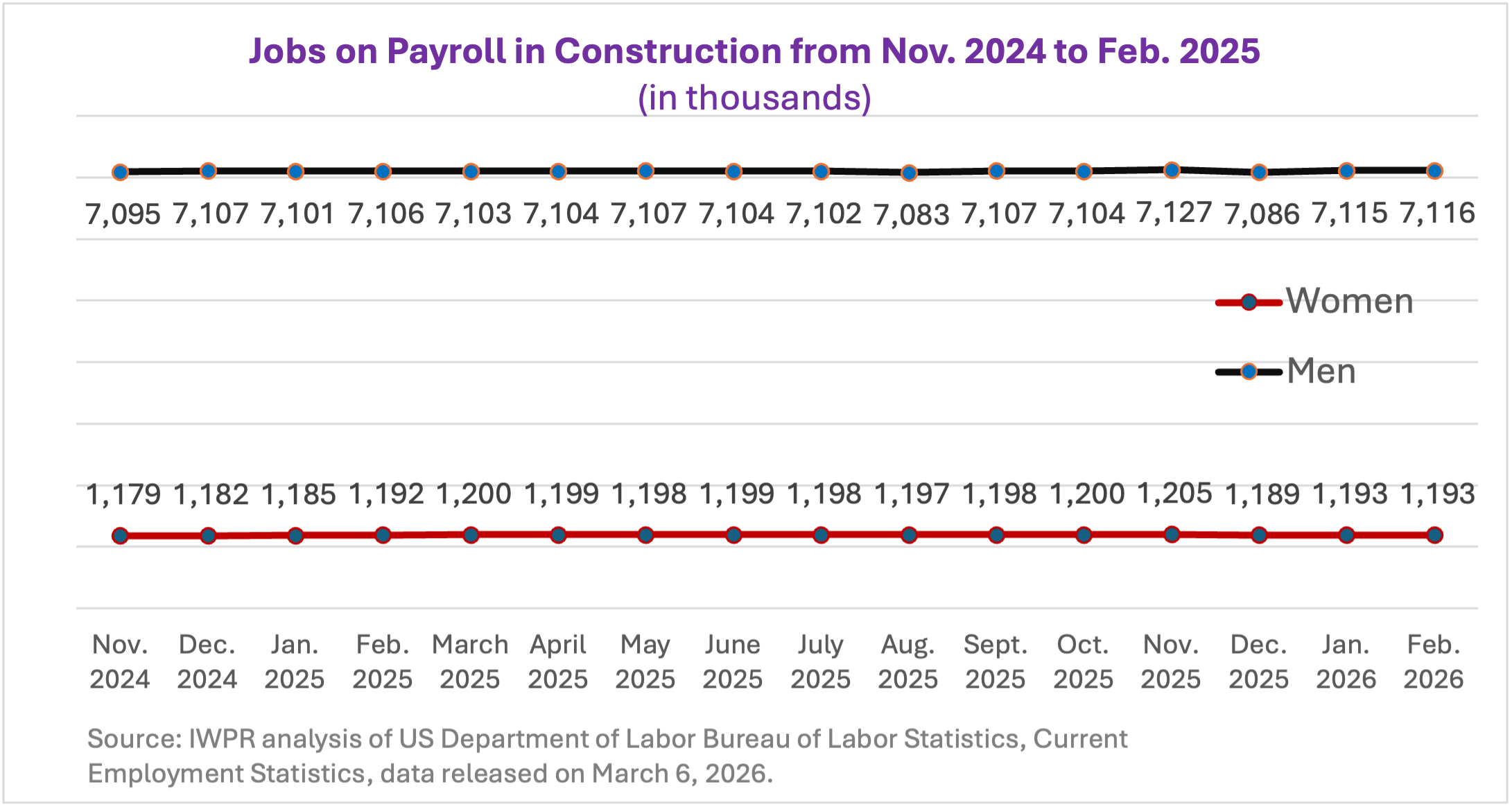
Between November 2024 and February 2026, the number of women on construction payrolls—counting only W‑2 employees—rose by 17,000 jobs. Women gained more than 40 percent of new jobs, raising their share of payroll employment marginally from 14.2 percent to 14.4 percent. This measure includes all W‑2 workers in the industry, from janitorial and administrative staff to construction managers.
A measure of the industry that includes independent contractors (but is based on a survey of households rather than employers) estimates that 1,369,673 women* worked in construction in 2025—a greater number than worked in the accounting, tax preparation, bookkeeping, and payroll services industry. Between 2015 and 2024, the number of women in the construction industry had grown by more than 45 percent, and their share of jobs increased from 9.3 percent to 11.2 percent. In 2025, women continued to make gains, increasing their share of jobs to 11.3 percent. An analysis of the 2025 Current Population Survey (CPS), which draws on microdata, suggests that Black women gained almost 20,000 construction jobs in 2025.
The number of tradeswomen working in specific construction occupations, such as electricians, carpenters, laborers, and plumbers—occupations often offering apprenticeships—held relatively steady at 364,000,* an estimated 2,360 fewer jobs than in 2024. This is within the margin of error, especially given caution about direct comparisons between 2024 and 2025 CPS data, as 2025 annual averages are missing October data. Women’s (albeit very low) share of tradesworkers’ jobs, at 4.3 percent, was unchanged. In some construction occupations, women’s share of jobs is substantially higher: In 2025, women were estimated to be 11.1 percent of painters and paper hangers and 4.7 percent of construction laborers, the largest single trade occupation.
The picture is similar for apprentices, who are the next generation of skilled tradesworkers. The number of women construction ‘active’ apprentices continued to grow, albeit by just 1.2 percent in fiscal year (FY) 2025—a much lower annual rate of growth than in the last decade, according to the Apprenticeship USA database. Given that there was also only modest growth among men ‘active’ apprentices, women’s share of all active construction apprentices, at 5.0 percent, stayed unchanged from FY 2024. Disconcertingly for the future of skilled workers in the industry, however, the number of ‘new apprentices’ (a separate category) fell sharply for both women and men, to just a little over a fifth of the number of new apprentices in FY 2024.
The most troubling trend concerns women construction managers. The 2025 BLS estimate for women construction managers, at 102,000, is almost 30,000 jobs* below the 2024 estimate. The decline in women’s share of all construction managers from 10.5 percent in 2024 to 8.5 percent in 2025 suggests that women were disproportionately affected by job losses.
The growing number of women construction managers prior to 2025 was one outcome of industry efforts to fully capture available talent. The industry needs to recruit a substantial number of new workers, on top of replacing workers reaching retirement age. As shown by trends between 2015 and 2024, efforts to improve diversity in the industry and recruit good workers—irrespective of their gender, race, or ethnicity—were beginning to bear fruit. In 2025, women generally fared as well as men in construction jobs. The business case for an inclusive and diverse construction industry continues to be recognized by the contractor community.
Practice and policies such as targeted outreach to women about job and apprenticeship opportunities in construction, unbiased recruitment and selection processes so that women with the prerequisite skills and experiences have the same chance at getting jobs as men, and measures to prevent discrimination and harassment at work make the workplace more hospitable and productive for women and for all workers. Likewise, pre-apprenticeship and other training programs that help women gain jobs in fields where they are a minority of workers remain crucial, a fact clearly recognized by the 2025 round of the federal Women in Apprenticeship and Nontraditional Occupations (WANTO) grant program.
The overall stability in 2025 jobs data points to women’s resilience as much as to the construction industry’s need for good workers. While one year of data does not make a trend, slow overall growth and the dramatic decline in both the number of women construction managers and the number of new construction apprentices are, however, matters for deep concern. Given women’s continued dramatic underrepresentation in construction, the industry can ill afford to slow its focus on recruiting and retaining women. Here’s hoping 2026 brings a resurgence in job growth for both women and men.
*IWPR analysis of data from the US Department of Labor, Table 18. “Employed people by detailed industry, sex, race, and Hispanic or Latino ethnicity, Annual Average 2025,” or Table 11. “Employed people by detailed occupation, sex, race, and Hispanic or Latino ethnicity, Annual Average 2025,” Current Population Survey (Washington, DC: US Bureau of Labor Statistics, 2026).
