Key Findings
- In 2025, women working full-time year-round made 83.9 cents per dollar earned by men—a wage gap of 16.1 percent, compared with 80.6 cents per dollar in 2024. This marks a surprising narrowing in the annual gender wage gap—which had increased two years in a row in 2023 and 2024—especially given that the weekly gender wage gap widened in 2025.
- The gender wage gap for all workers with earnings (including full-time, part-time, full-year, and part-year workers) also improved. In 2025, a typical1 woman worker earned 77.5 cents per dollar earned by a typical man, up from 75.3 cents per dollar in 2024.
- In the first year of the second Trump administration, which saw significant job losses for Black women between February and October, Black women earned 63.8 cents for every dollar that a White2 man earned. The racial and ethnic gender wage gaps widened for Black women working full-time year-round and for all Latina women workers with earnings, and White women led wage growth among women workers.3
- In a year with rising costs, women’s earnings growth is balanced against men’s plateauing earnings, shaping family economic security. Both women and men had increases in full-time year-round work, likely in response to the ongoing affordability crisis.
Gender Earnings Ratios Narrowed in 2025
In the first year of the second Trump administration, real earnings (inflation-adjusted) increased for women working full-time year-round by 3.2 percent, while men working full-time year-round saw their earnings plateau. As a result, the gender earnings ratio for full-time year-round workers increased significantly between 2024 and 2025 (Tables 1 and 3). This reverses a two-year trend of a widening of the gender wage gap. In 2024, women’s earnings stagnated while men’s grew.4 The gender wage gap has now returned to the same level as in 2022.5
When looking at all workers with earnings (including full-time, part-time, year-round, and part-year workers), the typical annual real earnings for women were 2.2 percent higher in 2025 than in 2024, while the typical earnings for men were 0.7 percent lower in 2025 than in 2024. As a result, the gender earnings ratio for all workers with earnings also improved, from 75.3 percent (a gender wage gap of 24.7 percent) in 2024 to 77.5 percent (a gender wage gap of 22.5 percent) in 2025. For all workers with earnings, the gender earnings ratio is still 0.8 percentage points worse than it was in 2022, during a historically tight labor market (Table 3).
Rather than signifying a material improvement in women’s labor market outcomes, the gender wage gap has returned to its 2022 levels.
Annual changes in women’s real earnings compared with men’s highlight many evolving opportunities and challenges women face in the labor market. The health care and educational services industry was the primary source of job growth in 2025, where women workers are concentrated at all levels.6 In occupations such as elementary and middle school teachers as well as nursing assistants, the gender wage gap in weekly earnings improved from 20247 to 2025.8 Yet earnings in this sector remain significantly lower compared with work in other sectors of the economy, for women as well as men.9 While unemployment remained low in 2025’s “low-hire, low-fire” labor market, when considering both hire rates10 and quit rates11 it is clear that workers have fewer opportunities to change jobs and negotiate higher earnings. Such “negotiation by job change” mechanisms have traditionally favored men more than women.
In addition, the persistent gender wage gap also reveals the many obstacles that women face to fully participate in the labor market, including disproportionate responsibilities for caregiving in their families and communities and insufficient work-family supports from their employers and through public policy. Women were 44.2 percent of all full-time workers in 2025 (compared with 44.3 percent in 2024) and 47.7 percent of all workers with earnings (compared with 47.4 percent in 2024). While women working full-time year-round saw larger earnings growth compared with all women workers with earnings, this did not translate into more women working full-time year-round.
Black Women Saw Earnings Decline and the Gender Wage Gap Increase
Black and Latina women have historically faced marginalization and exclusion in the labor market, which has resulted in their significantly lower median annual earnings in 2025 compared with White and Asian women, and with men in all the largest racial and ethnic groups (Tables 1 and 2). Furthermore, the first year of the second Trump administration saw Black women’s employment decline by 251,000 jobs before returning to prior levels in early 2026.12 Latina women also experienced increased immigration enforcement targeting their communities, which resulted in fear and uncertainty that likely shape the opportunities available to Latina workers.
In 2025, the typical earnings of Black women working full-time year-round were $51,950, a decline of 1.7 percent. This decline was nearly double the decline of 0.8 percent experienced by White men, resulting in a widened gender earnings ratio of 63.8 percent compared with White men ($29,500 less for full-time year-round work; see Table 1). The gender and racial wage gap for all Black women workers with earnings (including part-time and part-year) improved marginally from 62.3 percent to 64.0 percent of White men’s earnings (Table 2).
Latina women’s median annual earnings for a year of full-time work were $48,670, reflecting their occupational segregation into lower-paying jobs. As a result, Latina women’s earnings were just 59.8 percent of the median annual earnings for White men working full-time year-round (Table 1). This disparity resulted in $32,780 less in a single year for the typical Latina woman working full-time year-round13—money that could be spent on child care, education, and other investments in economic security. Latina women workers are less likely than women of other races/ethnicities to work full-time year-round, with only 63.4 percent doing so. For all workers, including part-time and part-year workers, Latina women’s earnings ratio worsened to 52.6 percent of White men’s in 2025, reflecting stronger earnings growth for all White men with earnings compared with Latinas with earnings (Table 2). For all Latinas working full-time year-round and working part-time and part-year, they earned $33,370 less than a White man, well over twice the average annual cost of child care in the US.
Across all groups, gender racial earnings ratios for full-time year-round workers worsened in 2025 for Black women, and improved for White, Latina, and Asian women (Table 1). White women made 80.7 percent ($15,730 less) and Asian women14 made 99.0 percent ($780 less) of what White men working full-time year-round earned.
When comparing all workers with earnings, White, Black, and Asian women saw the gender wage gap narrow in 2025. Compared with White men’s earnings, the gender racial earnings ratio for Asian women15 improved by 5.8 percentage points (to 89.6 percent), improved for Black women by 1.7 percentage points (to 64.0 percent), and improved for White women by 0.8 percentage points (to 72.9 percent), but worsened for Latinas by 1.2 percentage points (to 52.6 percent).16 For all Latinas working full-time year-round and working part-time and part-year, they earned $33,370 less than a White man, well over twice the average annual cost of child care in the US.
Pay Equity Is Generations Away for Working Women
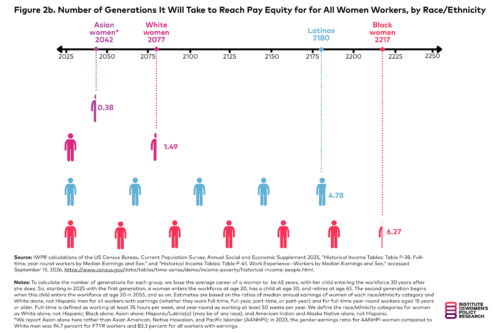
The wage gap remains significant, and progress toward closing it has slowed substantially compared with earlier decades (Figure 1). By projecting into the future the changes in the gender earnings ratio over the last two decades (2002 to 2025; see Figure 2), we find it will take almost five decades—until 2071—before full-time year-round women workers reach pay equity with men. It will take even longer—until 2086—for pay equity between all workers with earnings.17
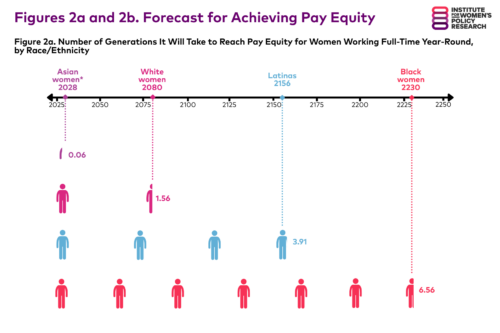
All groups of women will not experience pay equity in their working lives, but the progress toward parity is even longer for Black and Latina women. Not only do Black and Latina women workers have lower gender earnings ratios compared with White men, but the rate of progress is also slower. It will take more than a century—until 2230 and 2156, respectively—for Black and Latina women to reach pay equity, even when working full-time year-round. In practice, this means more than six generations for Black women and nearly four generations for Latina women to have equitable earnings.
Policy Solutions to Tackle Gender and Racial Inequity in Earnings
The progress toward pay equity depends on policy change. The gains women made in labor force participation, the types of jobs available to them, and their earnings growth in the second half of the 20th century resulted directly from deliberate policy choices. The passage of the Equal Pay Act of 1963,18 the creation of the Equal Employment Opportunity Commission in 1965,19 amendments to the Fair Labor Standards Act in 1966 and 197420 that expanded coverage to sectors with higher concentrations of women and workers of color, Title IX of the Education Amendments of 1972 prohibiting sex discrimination in higher education,21 and the establishment of the federal constitutional right to abortion under Roe v. Wade in 1972 (until it was overturned by the Dobbs decision in 2022) all led to more opportunity for women to be fully engage in the labor force. The relative lack of large-scale policy advancements to promote gender justice and fairness in the labor market since the turn of the 21st century (with some exceptions, including the Affordable Care Act) has resulted in stalled progress and dreams deferred. Markets alone will not solve gender and racial pay equity.
Policymakers at the federal, state, and local levels have a range of tools to tackle pay equity, close the gender pay gap, and promote fair wages for all workers. Higher earnings for women will result in greater investments in families and communities, and stronger and more resilient economic growth. As the gender wage gap finally improved after two years of backsliding, the regained ground reinforces the imperative to address pay equity for the sake of all workers. A key part of addressing the affordability crisis is promoting tools that ensure women workers are paid their fair share. The evidence-informed policy solutions to help to address the diverse factors that contribute to the pay gap include:
Protect, support, and improve worker protections.
This includes a renewed commitment to fully monitor, uphold, and enforce existing federal worker nondiscrimination protections and statutes. Currently, enforcement agencies such as the Equal Employment Opportunity Commission and the US Department of Labor’s Office of Federal Contract Compliance Programs have reduced and restricted their capacity to address the very real discrimination that women and minority groups experience in the labor market, exacerbating the backsliding of progress.
Promote higher wages and better job quality for women.
This includes a range of policy actions at both the federal and state levels, such as increasing the minimum wage, abolishing the tipped minimum wage, addressing wage theft, and supporting workers’ right to act collectively and join or form a union.
Expand policies that assist caregiving for families.
Policymakers should promote and expand access to paid leave for all workers for a minimum of 12 weeks. Investments are needed to create and expand systems where child and elder care are accessible and affordable for everyone. Additionally, women’s overrepresentation in low-paid care jobs must be addressed through policies that raise wages in these occupations and industries.
The fact that closing the gender wage gap will take several generations is a sobering reality. But it’s not a reason to accept unfair gaps in today’s job market. Every advancement toward equity that we benefit from today is a hard-fought policy win from a host of ancestors: unions and workers’ rights advocates, civil rights movements and racial reckonings, and women bringing their own chair into the room when they weren’t given a seat at the table. As we benefit from these advancements in gender and racial justice, we must learn from those who stewarded the radical hope that another world is possible. A deregulated economy will not address structural disparities and market failures like women’s lower pay. Ultimately, promoting these and other bold policy solutions will accelerate the timeline to achieve pay equity—and support a more dynamic economy with better opportunities for all.
To learn more about related legislation and executive priorities advancing these and other IWPR federal policy solutions on Equitable Work and Wages, go to iwpr.org/federalpolicyagenda. For information on the current policy landscape, policy recommendations, and legislative tracking in the states, visit statepolicyactionlab.org.

This fact sheet was prepared by Dr. Kate Bahn and Miranda Peterson, with data analysis conducted by Pamela Alvarado, Dr. Mrinmoyee Chatterjee, Comfort Sampong, and Dr. Aashima Sinha. Thank you to our key funders for their generous support of IWPR’s core research and flagship products.